 HOME
HOME
Sub-theme1
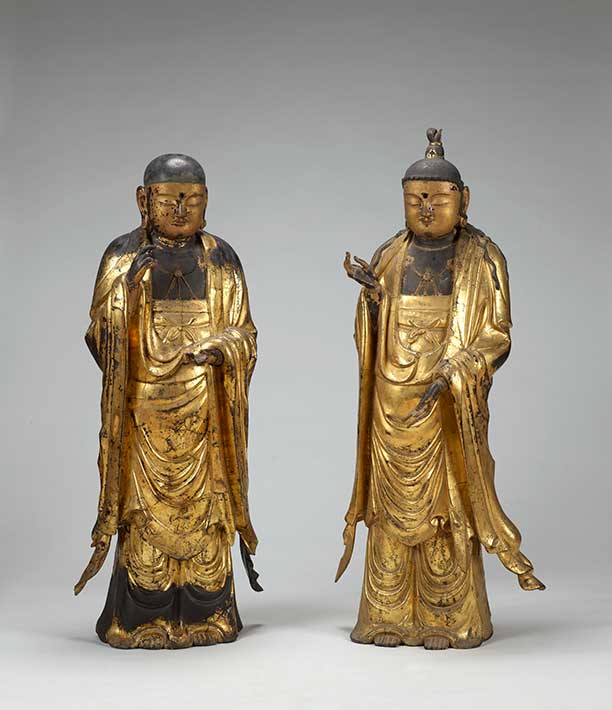
- Early Joseon Dynasty
- Wood and clay
- duk 1780, duk 2209
This set of statues shows Avalokiteshvara and Kshitigarbha as a pair. Blocks of wooden splinters connected by nails were carved into the statues, and a layer of clay was thinly applied to the overall surface of each. Delicate parts such as the faces, the chins, and the drapes were shaped upon the clay surface. The carved surface was overlaid with hemp sheets, and then black lacquer was applied over the hemp layers before gilding. This carving method exploits both the hardness of wood and the softness of clay. The faces of the bodhisattvas were rendered somewhat rectangular, and the lower bodies longer than the upper bodies. The three-strand ornaments suspended at the chest level and the drapes over the legs are the traits of the fifteenth-century bodhisattva statues. It is highly likely that this pair originally constituted a triad whose central figure was Amitabha Buddha.
 Prev
Prev
